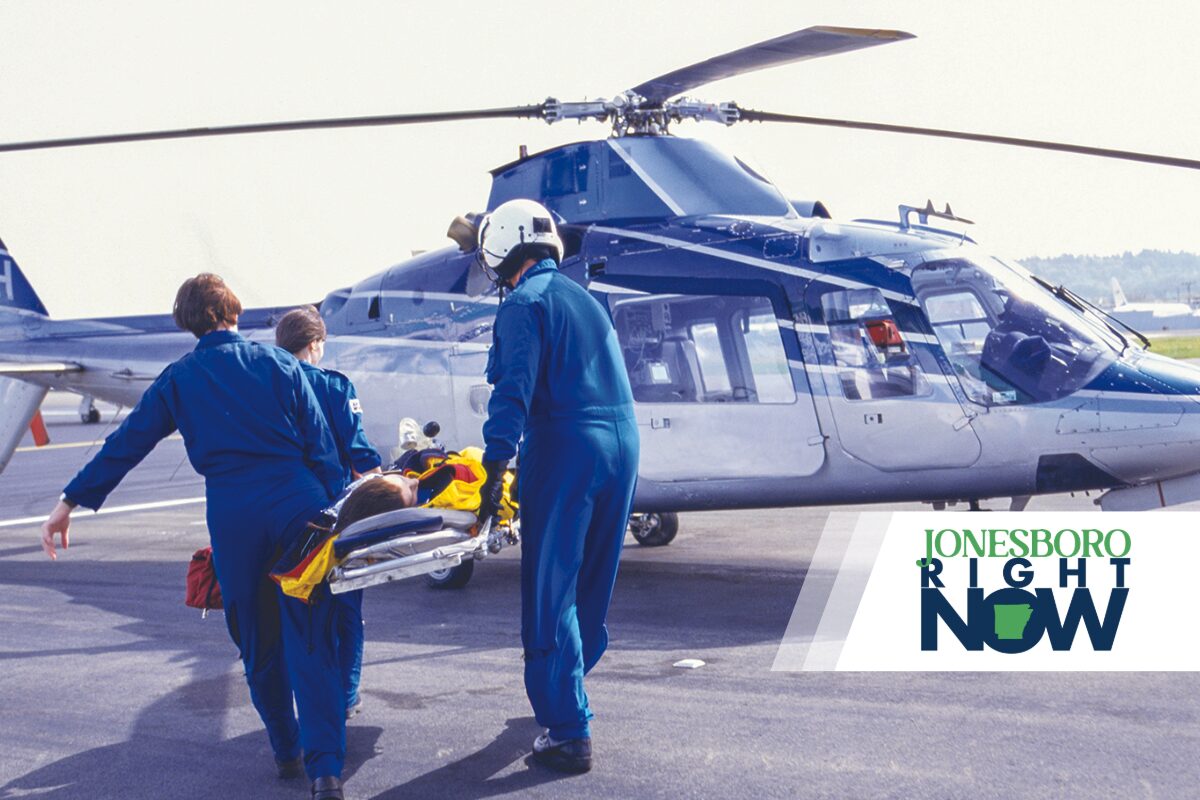
Jonesboro, AR – JonesboroRightNow.com – It is a sound that has become a regular part of the soundscape in Northeast Arkansas: the rapid, percussive thrum of rotor blades cutting through the air, signaling a critical medical emergency in or around Craighead County.
For victims of high-speed crashes on highways, farmers injured in remote fields, or patients experiencing severe medical events in rural communities, that sound represents the “golden hour.” It is the critical window where rapid transport to a definitive care facility can dramatically improve patient outcomes.
| ADD US ON GOOGLE NEWS: Click here to see more local news from Jonesboro Right Now
“Our goal is always to get them out of the wrecked vehicle, or whatever’s going on, as quickly as we can, because you’ve got that golden hour,” Jonesboro Fire Chief Marty Hamrick said. “From the time of injury to the time they’re at definitive care. If you can do that in less than an hour, it greatly increases their chance of survival.”
Behind the rush to save a life is a complex web of logistical protocols, regional healthcare partnerships, and insurance guidelines. JRN spoke with experts regarding these air medical transports to understand how local first responders, flight crews, and regional hospitals collaborate to provide seamless care.
Securing the Scene
Despite market reports showing a national surge in demand for Helicopter Emergency Medical Services (HEMS), the logistics inside the Jonesboro city limits require specialized coordination.
Hamrick noted that local hospitals are heavily utilized to stabilize patients, so the frequency of urban helicopter landings has actually decreased slightly.
However, when a major urban incident occurs, and rapid transport is required, bringing a helicopter to the scene is a massive logistical undertaking. The process requires a 100-foot by 100-foot clear perimeter and seamless communication between multiple local agencies.
To secure the area, Jonesboro Fire Department (JFD) protocols require two battalion chiefs to stage at the front and back of the landing zone, while law enforcement is brought in to block traffic. Crews must constantly assess the environment, sometimes moving to safer locations, such as a large parking lot, to avoid traffic interference and ensure a clear space for the flight crew.
“The power lines are usually the biggest [issue], because they’re a little harder for the pilots to see, especially at night,” Hamrick said.
The Dispatch Decision
The decision to launch an aircraft relies on rapid clinical assessment. In Arkansas, this is coordinated through the Arkansas Trauma Communications Center (ATCC), a 24/7 statewide hub staffed by medical professionals.
Dr. Kyle Kalkwarf, medical director of the trauma program at the University of Arkansas for Medical Sciences (UAMS) in Little Rock, explained that the ATCC maintains an up-to-date listing of all hospitals in the state that serve as trauma centers and the resources they have available.
“The EMS providers who arrive at the scene call the ATCC, and the ATCC looks at their dashboard and says, ‘This is the closest, most appropriate hospital to care for this patient.’ We’re trying to line up the needs of the patient with the capabilities of the center,” Dr. Kalkwarf said.
Locally, this rapid assessment begins the moment an ambulance arrives. At NEA Baptist Memorial Hospital, highly critical cases designated as “Alpha” traumas trigger an immediate hospital-wide response.
“It’ll call the surgeons and surgical staff in, I think the ICU comes to help out, and then also the lab comes, and they bring some blood products as well,” said Dr. Justin Baggs, medical director for the Emergency Department of NEA Baptist.
His team performs a ‘fast exam’, which is an ultrasound to check for internal bleeding. This is while the staff assesses the patient’s breathing and circulation before moving to a CT scan. When a patient is highly unstable, such as suffering from severe internal injuries that the local team cannot address, Dr. Baggs’ staff contacts the ATCC to initiate a transfer.
Baggs noted that for Northeast Arkansas, proximity is key, meaning they often consult with trauma surgeons at Regional One Health in Memphis. The decision to fly rather than drive can even come down to the time of day.
“There’s a lot of factors involved. If it’s four or five o’clock, you know, with Memphis traffic, we all kind of factor that in,” Dr. Baggs said.
The ultimate goal, he added, is preventing a patient from “crashing,” a medical term for rapid clinical deterioration, in the back of a ground ambulance when resources are limited.
Once the helicopter arrives, a flight nurse and paramedic meet the hospital team directly at the bedside for a seamless handoff, reviewing the treatments already administered and any recommendations from the receiving hospital.
Stabilization and Handoff
While scene flights get the most public attention, a significant portion of the region’s air medical transport is dedicated to inter-facility transfers.
According to Kelly Watson, a spokesperson for Global Medical Response (which operates Air Evac Lifeteam), transport volume is split fairly evenly between 911 scene calls and inter-facility transfers, with the overall regional volume remaining “relatively stable” over the past few years. This trend is reflected at the state level, as Dr. Kalkwarf noted that helicopter transfers to UAMS actually decreased slightly from peaks in 2021 and 2022.
Local Level III facilities play a crucial first step in this continuum of care, providing initial stabilization before patients are transitioned to flight crews.
At St. Bernards Medical Center, the goal is to treat trauma patients entirely in-house whenever possible. Mitchell Nail, media relations manager for St. Bernards, said the hospital serves as a regional transfer center for 23 counties and operates as an “advanced” Level III facility.
“We offer more than just your standard run-of-the-mill Level III trauma center,” Nail said, pointing to their round-the-clock orthopedic hospitalists and newly expanded neurosurgery capabilities.
When a flight in or out is necessary, the coordination is seamless. Nail explained that the emergency department considers med flight crews part of their team. Flight crews landing on the hospital’s fifth-floor helipad take a direct route down to the emergency department or straight into surgery.
Crossing State Lines for Care
For many critical patients in Craighead County, proximity dictates that the fastest route to a Level I trauma center could mean crossing the state line into Tennessee.
“Every year we care for around 1,500 patients that come in as significant trauma victims from Arkansas,” said Joshua Dugal, vice president for Trauma and Burn Services at Regional One Health.
For Dugal, severe trauma is a “surgical disease.” The most severely injured patients require immediate surgical intervention, necessitating resources that standard community hospitals may not be able to provide. To meet this need, Regional One Health maintains four trauma operating rooms fully staffed 24 hours a day, 365 days a year.
When the Memphis MedCom team receives word of an inbound flight, they use objective criteria such as vital signs and the severity of the incident to assign a trauma activation level. A top-tier “Shock Trauma One” activation prompts a team of roughly 15 specialists, including surgeons, anesthesiologists, and respiratory therapists, to wait at the patient’s bed, with an operating room team standing by in the hall.
Dugal said that when the helicopter touches down, a specialized team meets the flight crew on the rooftop, transfers the patient while “working underneath those spinning blades,” then rushes down an elevator positioned just 25 feet from the trauma bays. The medical handoff takes only a minute and uses the “MIST” format to rapidly communicate crucial patient information. MIST stands for: Mechanism of injury, Injuries identified, Symptoms, and Treatments already provided.
The In-State Ecosystem
Not every critical patient flies east. As the only adult Level I trauma center within Arkansas’s borders, UAMS supports the state’s internal trauma network by providing continuous resources that smaller facilities may not be able to maintain.
Much like Regional One, UAMS maintains 24/7 in-house surgeons, anesthesiologists, and operating room staff ready at a moment’s notice.
“We also have more specialties to care for the patients, for example, we have urologists and obstetricians and vascular surgeons who aren’t necessarily always here, but are always available,” Dr. Kalkwarf said.
When the ATCC routes a patient to UAMS, a massive mobilization occurs while the helicopter is still in the air. Messages are dispatched to trauma surgeons, residents, operating room staff, anesthesiologists, radiology technicians, and respiratory teams.
To ensure the entire state network remains strong, UAMS regularly reviews the run sheets from these flights and provides vital feedback to the local paramedics and flight crews who initiated the transfer.
“We all want the best thing to happen to trauma patients, and we love it when we see the right things are done, because that helps the patient have better outcomes,” Kalkwarf said.
Navigating the Financial Landscape
When it comes to air medical transport, financial considerations can be top of mind for a patient who should be focused on getting to care quickly, rather than on how much the transport will cost or whether their insurance will cover it.
In 2022, the No Surprises Act (NSA) was implemented in the United States to protect patients from out-of-network balance billing for emergency services. Under the NSA, patients are generally responsible only for their normal in-network deductibles and copays.
However, there is an important caveat regarding “medical necessity.” If a patient’s health insurance company reviews the claim and determines the flight did not meet its specific medical-necessity guidelines, the NSA protections may not apply.
“The NSA does not apply to claims when there are no air ambulance benefits or if the service is denied for not meeting the medical necessity guidelines established by the insurance plan,” Watson confirmed.
To provide residents with an alternative, Global Medical Response uses a subscription model called the AirMedCare Network (AMCN). Residents can pay an annual membership fee that covers out-of-pocket flight costs incurred by an AMCN provider.
For emergency room physicians making the initial call, however, the immediate focus remains entirely clinical. When asked whether there is time to discuss the significant financial burden of an air transfer with families, Dr. Baggs indicated that patient care was the priority.
“We don’t talk about the finances,” Dr. Baggs said. “In certain cases, we’ll ask if they have flight insurance, and they’ll say, ‘Oh yeah, we’re with Survival Flight.’ And then we’ll call them first. But most of the time, I don’t have time to discuss their finances.”
Regional hospitals also recognize the financial weight of these transports. Both UAMS and Regional One connect patients with social workers and case managers to navigate insurance claims, find financial assistance, or even sign up for health coverage directly from their hospital beds. Regional One also provides charity care for those without the means to pay.
“We don’t want to turn away anybody, and we never do based on their ability to pay, especially in a traumatic, life-threatening situation,” Dugal said.
Nail echoed this sentiment, emphasizing that St. Bernards has dedicated staff to help patients navigate insurance and financial assistance after the fact so that cost never deters someone from seeking emergency transport.
“Don’t let cost be the reason that you don’t do that. Because those minutes can mean the difference between life and death,” Nail said. “I understand finances are a burden, but we want that to be the last thing that’s on your mind, especially when you’re experiencing an emergency.”
| DAILY BRIEF: Sign up for the Jonesboro Right Now Daily Brief Newsletter